
St. Charles City Directory Collections
St. Charles city directories are held through several local and statewide routes, but the documented microfilm is a set of separate years rather than a continuous series. The official holdings guide lists 1906, 1934, 1936, 1948, 1950, 1952, 1955, 1957, and 1959. That pattern matters. A missing name in one volume can reflect a gap in the shelf, a spelling change, or an unlisted household, not proof that someone was absent from St. Charles.
| Collection | Years or scope | Where held | Access |
|---|---|---|---|
| St. Charles city-directory microfilm | 1906, 1934, 1936, 1948, 1950, 1952, 1955, 1957, 1959 | St. Charles County Library and the official St. Louis County Library holdings guide | Discrete microfilm years; verify reader and branch availability |
| Bizelli-Fleming Local History Collection | Additional directory run not located in official sources | Kathryn Linnemann Branch | In-library local-history research and library databases |
| Missouri Digital Heritage directories | Missouri collections; no continuous St. Charles run confirmed | Secretary of State digital collection | Name, address, occupation, or date search where a digitized item supports it |
| Reverse and criss-cross volumes | Local titles and dates not separately confirmed | Library or Historical Society inventory | Ask about address-section access before relying on one |
The St. Charles County Library genealogy collection is the practical first contact for library-held directories, census tools, maps, yearbooks, newspapers, and local-history material.
Use the library route to confirm whether a needed volume, microfilm reader, or database is available before making a trip. No official source captured a complete publisher list, a last printed year, or a continuous annual St. Charles run.
Note: Treat the listed years as separate historical snapshots, and retain the source year beside every transcription.
St. Charles City Directory Research Desk
The Kathryn Linnemann Branch at 2323 Elm Street is associated with the Bizelli-Fleming Local History Collection. Its genealogy resources name census, vital, military, immigration, naturalization, wills and probate, land and tax, directories, maps, photographs, yearbooks, newspapers, and local history. Ancestry Library Edition is an in-library resource, while HeritageQuest and MyHeritage Library Edition are listed for at-home use; FamilySearch and Fold3 are also named research routes. Licensed collections can change, so their current access terms should be checked with the library.
For a directory search, take the full name, known spelling variants, approximate year, and an old address if one is known. The library can help connect a directory reference with its related map, newspaper, or yearbook source. That is often more useful than trying to force an incomplete entry to answer every family question.
St. Charles Directory Family Files
The St. Charles County Historical Society can add a local layer when a directory gives only a name and number. Its reported holdings include city directories, census indexes, street files, deeds and abstracts, court books, maps, local newspapers, church and cemetery material, and family-history files for more than 75,000 people. Those files may point to photographs, letters, an obituary, or an unpublished family history, but they should not be assumed to be completely indexed online.
The archive is at the Old Market House, 101 S. Main Street, St. Charles. Research hours listed by the Society are Monday, Wednesday, and Friday from 10:00 a.m. to 3:00 p.m., with Saturday visits by appointment. Supply the surname spelling, relationship, and period of interest when asking about a file. That focused request helps distinguish a long-established St. Charles family from a same-name match.
The Historical Society archive is a physical research route for directory work, not a promise that every historical item is digitized.
Pair a directory citation with the archive's supporting material only after checking the year, address, and family relationship shown in the original entry.
Reading St. Charles City Directory Entries
No image of a St. Charles directory page was opened during the source review, so abbreviations and marks should be read from the key in the specific volume. When an entry is visible, record its full context rather than copying only a surname. Historical entries can use initials, French or German name variants, spouse-in-parentheses wording, a widow notation, street abbreviations, and owner, renter, or boarding information.
| Name line | Surname, first name or initials, and any printed alternate or spouse notation |
|---|---|
| Household clue | Spouse in parentheses, widow wording, owner or renter mark, or rooming and boarding notation when shown |
| Address | Exact number, street spelling, direction, and any residence or business distinction printed |
| Historical affiliation | Occupation, employer, or business only as printed for that directory year |
| Citation details | Volume year, page, and the abbreviation key needed to interpret the entry |
- Criss-cross directory
- An address-first section that can lead from a street number to a listed occupant. It does not establish ownership.
- Householder index
- A list organized around the household or address relationship rather than a complete census of everyone present.
- Abbreviation key
- The volume's own explanation of shortened words and symbols. Photograph or transcribe it with the entry.
St. Charles City Directory Address Clues
A reverse or criss-cross section can begin with an address when the name is unknown. Search the exact number and the period street spelling, then preserve any spouse, household, or boarding notation as it appears. Local holdings for these reverse directories are not separately dated in the research, so ask the library or Historical Society whether a matching volume exists instead of assuming the address section covers every listed year.
Directories describe a point in time. A tax mailing address can belong to someone who did not live at the property, and a historical directory listing does not establish ownership. For a current parcel or deed-chain question, use the address-focused records on the St. Charles street directory route rather than extending a historical entry beyond what it says.
Note: Keep old street spellings and directions exactly as printed, since a modern map search can otherwise miss the same block.
St. Charles Heritage Center Directories
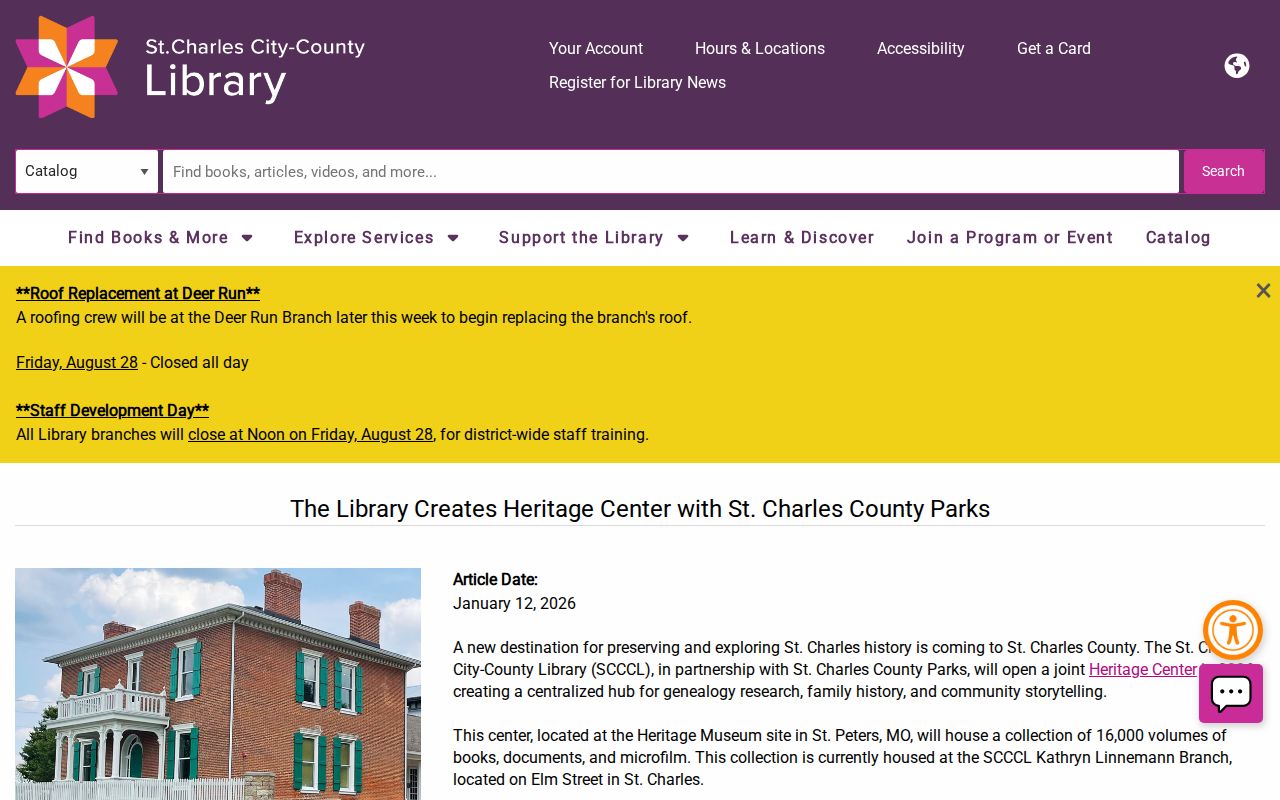
On January 12, 2026, the library and County Parks announced a Heritage Center at the Heritage Museum in St. Peters, expected to open in mid-to-late 2026. The announced 16,000-item local-history collection is currently at Kathryn Linnemann and includes old phone books, newspapers on microfilm, church and marriage records, and a sound studio. The announcement signals a future research location, not that all material has already moved or become available online.
The Heritage Center announcement provides the library's description of the collection and planned transition.
For a directory or phone-book request, confirm the current location with the library before travel, especially while the collection is being prepared for the Heritage Center.
Trace a St. Charles City Directory Household
Following one household through the available city directories works best as a documented sequence, not as a straight annual timeline. Use the most recent relevant listed edition first, then move to the closest earlier edition. The federal census can provide a second dated snapshot under the National Archives' 72-year release rule, while an obituary, deed, permit, or probate record may explain a move, sale, or death.
- Normalize the surname and street abbreviations, then note every spelling variant worth testing.
- Find the target in the latest available local volume and save the year and page.
- Work back through the closest listed years, recording addresses, spouse wording, and any household marks.
- Use a reverse section when available to test the same address from the other direction.
- Pair directory dates with released federal census material, treating both as snapshots rather than continuous occupancy.
- Use a deed, obituary, permit, or probate date to test a change without guessing its cause.
- Finish with the original source citations so another researcher can evaluate the match.
St. Charles City Directories and Maps
St. Charles has several historical layers to compare. The city began as Les Petites Cotes in 1769, was incorporated in 1809, and served as Missouri's first state capital from 1821 through 1826. Its county-seat role adds court, land, church, and business references that can predate a modern address system. A directory entry gives a name at a number, but it cannot by itself show the built form of that block or the full history of a household.
The 1893 Missouri Digital Heritage scan and the 1917 Library of Congress Sanborn map set are useful building-and-block checks. Compare them with a directory citation carefully: maps show structures, lots, uses, and street context, while city directories list the people or places printed in that edition. Neither source proves every resident at an address.
St. Charles Directory Access Gaps
Several limits should remain visible in a St. Charles directory search. Official sources did not identify the first publisher, last printed edition, a complete run of local reverse directories, a named obituary index with coverage years, or a full list of digitized St. Charles volumes. The Historical Society reports newspapers reaching back to the mid-19th century, yet exact digitized titles and years were not located. Those are research gaps, not permission to fill the gaps with a guessed timeline.
For a difficult name, ask an archive worker to check the spelling, volume year, and likely companion source rather than requesting a broad person search. A clear request might name the street, a short date range, a spouse or parent, and the question being tested. That gives the library or Society a workable way to check a shelf, vertical file, obituary collection, church record, or map without turning a historical clue into an unsupported identification.
When an online search stops, use the library, a Historical Society visit or inquiry, the Missouri State Archives, and the appropriate record custodian. Oak Grove Cemetery has no public online interment lookup in the research, so a direct cemetery or archive inquiry is the fallback for burial evidence. Historical materials may be available only through a reader, file, microfilm reel, or staff-assisted request.
Note: A missing online result may only mean that the volume, file, or local index has not been digitized.